Guide · No signal
How to talk to your group when there is no mobile signal.
Mobile signal disappears in valleys, on mountains, deep inside buildings and in crowds that overload the local mast. The groups that cope best are the ones that planned for it before they set off. Here is how to plan, what your options are, and where a phone-to-phone app fits.
Where signal drops, and why
A phone needs a clear path to a mast. Hills, cliffs and valley walls block that path. Thick walls, basements, car parks and steel-framed buildings soak up the signal. And at a big event, thousands of phones in one field can be more than the local mast can serve, so you may see bars and still fail to get a message through.
You cannot always predict which of these you will meet, so the safest plan assumes the signal will go at the worst moment.
Plan before you go
Agree a plan in person
Before the group splits, agree where everyone is going, the route and the time you expect to be back.
Tell someone at home
Leave your route and return time with someone who is not going, and agree when they should raise the alarm.
Set meeting points
Pick a clear landmark and a time: "the info tent at the top of every hour", "the trail sign at the lake by two". If you lose each other, go there.
Set a fallback time
If someone has not arrived by a set time, the group knows what to do next, without needing a phone to decide.
Charge everything
Phones, power banks and any radios. No signal makes a phone search harder for a mast, which can drain the battery faster.
Download maps
Save offline maps of the area before you go, so navigation keeps working without data.
Your options when the bars go
- Text messages: an SMS sometimes gets through on a weak signal when calls and data fail, so it is worth trying before you give up.
- Two-way radios: dedicated handsets talk to each other directly, with no network at all. Range depends heavily on terrain and buildings.
- Satellite messengers and satellite-capable phones: these exist for places with no mobile network at all, and are worth looking into for remote trips. Check what your device supports and what it costs before you rely on it.
- Phone-to-phone apps: some apps link phones that are near each other directly, over Bluetooth and Wi-Fi, with no mobile network. Their reach is limited to how far those links carry between phones.
- The old ways: a whistle, a torch and a meeting point still work when every battery is flat.
Talking with no signal on TapHAIL
TapHAIL is a free push-to-talk walkie talkie. With a network, it reaches anywhere over mobile data or Wi-Fi. When the network goes, Android phones near each other keep talking directly over Bluetooth and Wi-Fi, so a group walking together, or spread across one site, can keep pressing to talk with no bars.
When the network comes back, History syncs, so the transmissions made offline are kept with everyone else's.
Offline nearby talk is Android to Android only. The web app and iPhone (which uses the web app for now) need a network. How far phones reach each other depends on the phones and the place, so test it with your group before you depend on it.
Before you leave the car park
- Install TapHAIL on every Android phone in the group and join one channel while you still have signal.
- Keep Bluetooth and Wi-Fi switched on, and try offline talk together somewhere without signal before you depend on it.
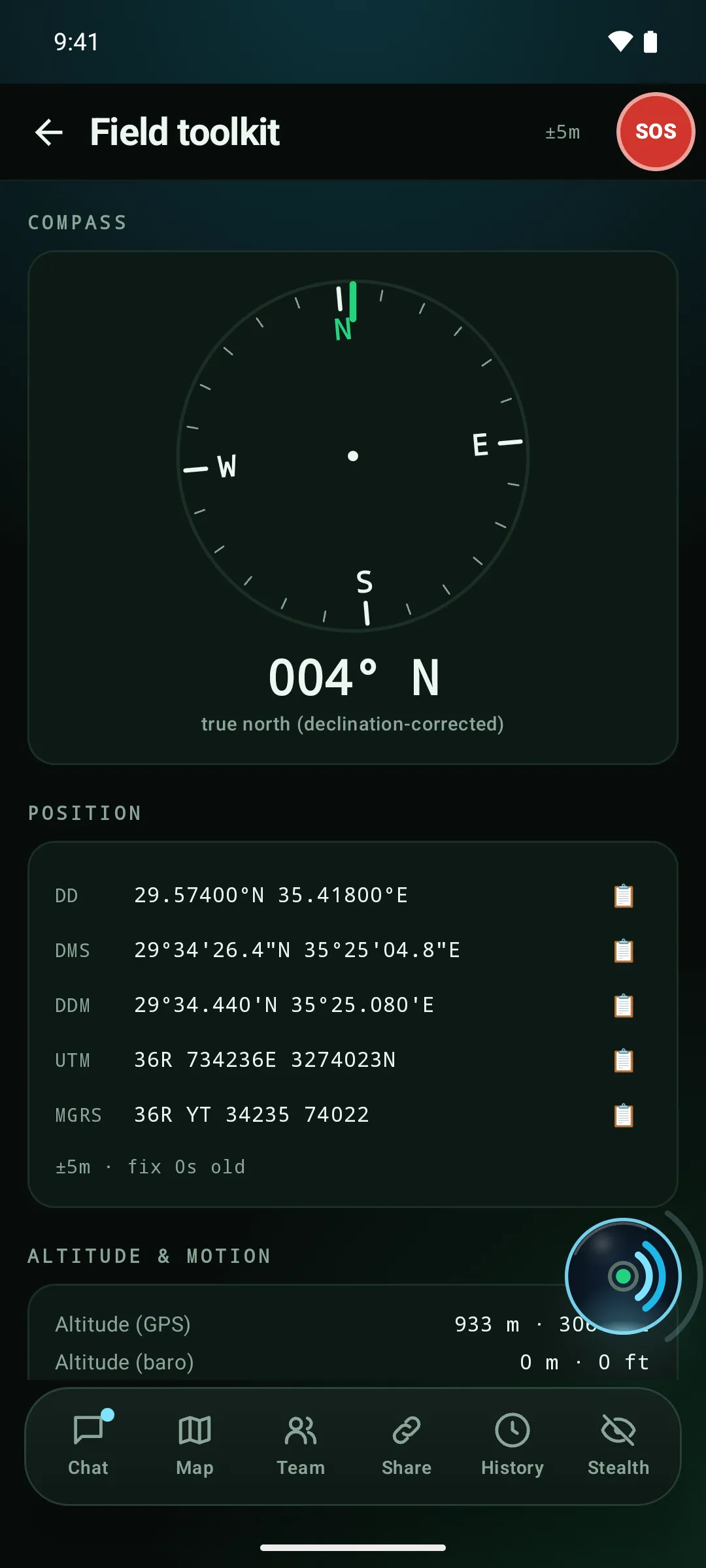
- Open the field toolkit: compass, coordinates in DD, DMS, UTM and MGRS, and altitude, so you can tell someone exactly where you are.
- Agree that the meeting point and fallback time still stand, whatever the app does.
In an emergency
TapHAIL has one-tap SOS that, where SOS is live (Kerala today), alerts your channel and an emergency contact with your location, but it does not replace emergency services. In an emergency, call your local emergency number. Many countries let you reach emergency services on any available network, so try a call even with no bars.
Questions
Can I talk to friends with no mobile signal?
Yes, if you planned for it: two-way radios, satellite devices, or a phone-to-phone app such as TapHAIL on Android, which links nearby phones over Bluetooth and Wi-Fi with no network.
What does TapHAIL use when there is no signal?
On Android, offline nearby talk uses Bluetooth and Wi-Fi directly between phones, so keep both switched on. When the network returns, History syncs.
How far does offline talk reach?
It depends on the phones and the place: walls, terrain and crowds all shorten it. Test it with your own group before you rely on it.
Does offline talk work on iPhone?
Not yet. Offline nearby talk is Android to Android. iPhone users use the web app for now, which needs a network.
Should I rely on an app in an emergency?
No app replaces emergency services. In an emergency, call your local emergency number.